AI Is Changing How Customers Find You
ChatGPT, Google AI and voice assistants are the new Yellow Pages. Here's how to make sure your business gets recommended.

ChatGPT, Google AI and voice assistants are the new Yellow Pages. Here's how to make sure your business gets recommended.
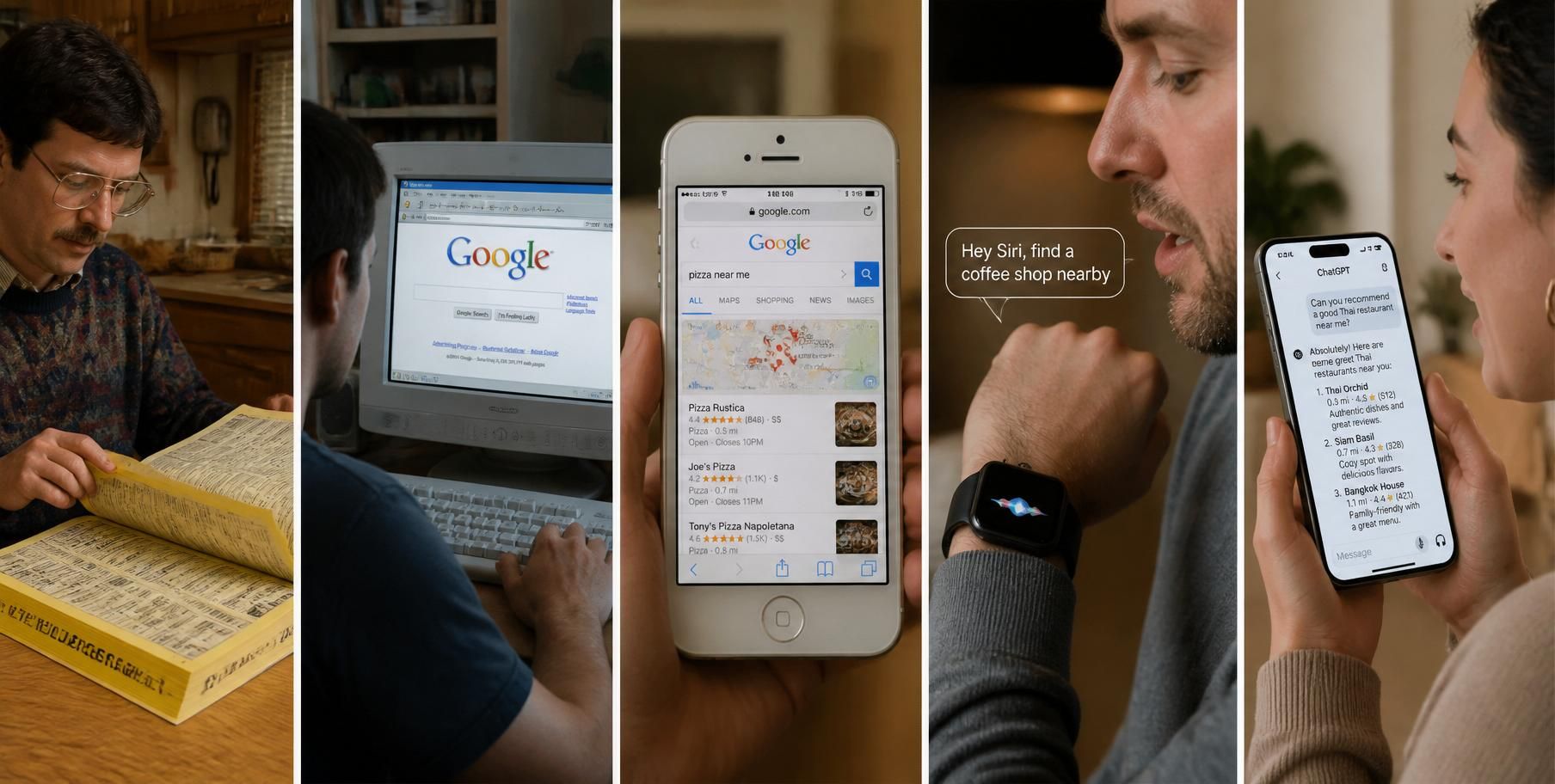
Not long ago, if a burst geyser flooded your kitchen at 9pm, you grabbed the Yellow Pages, ran your finger down the plumbing column, and phoned whoever had the biggest advert. Then Google arrived, and you typed "emergency plumber near me" instead. Now something new is happening. People are opening ChatGPT and simply asking: "Who's a reliable plumber in Somerset West that works after hours?" — and getting a short, confident list of names back.
If your business isn't on that list, you don't lose the job. You never even knew the job existed.
This is the quiet shift reshaping how South African customers find local businesses. It isn't hype, and it isn't only a big-company problem. It affects the plumber, the electrician, the solar installer, the accountant, the furniture maker — anyone who relies on being found and being trusted. The good news: the things that make an AI recommend you are largely the same things that have always made a business look credible. You just need to understand how the new gatekeepers read the world.
This guide explains, in plain language, how we got here, how AI search actually works, why websites still matter more than ever, and exactly what to do about it.
How People Used to Find Local Businesses
For most of the last century, finding a local business was a physical, social act. You asked a neighbour. You looked in the phone book. You saw a signboard on the side of the road, or a magnet on the fridge from the last guy who fixed your gate.
Word of mouth was — and still is — powerful. In close-knit and community-based markets, a personal recommendation carries enormous weight. But word of mouth has a ceiling. It only reaches people already connected to your existing network. It can't introduce you to the family that moved into the area last week, or the person three suburbs over who's never met anyone who's used you.
The Yellow Pages solved part of that. It was the first true discovery tool: a single trusted directory where a stranger could find you, sorted by category and area. For decades, being in the book — ideally with a bold or boxed advert — was how you reached people beyond your circle.
The pattern worth noticing is this: customers have always needed a trusted source that tells them who exists and who is worth calling. The source keeps changing. The need never does.
From Yellow Pages to Google to AI
The role of the business website has changed dramatically over the past thirty years, and each shift changed what it took to get found.
In the 1990s and early 2000s, business websites were essentially digital brochures — static pages listing your services, location and phone number, often built by a local IT shop, with no real search strategy behind them. In developing economies including South Africa, early adoption was slow because of limited infrastructure, high costs and low awareness. Many small businesses simply weren't online at all.
Then search engines matured (mid-2000s to 2010). Google became the front door. Websites turned into the main way a business could rank when someone searched — and "local search," where people look for services "near me" or in a specific town, became its own category. A website stopped being a nice-to-have and became the thing that let you appear at all.
The mobile revolution (2010–2015) changed the urgency. Suddenly people searched on their phones, often with immediate intent — "I need an electrician now." Businesses without a fast, mobile-friendly site to send people to started losing those immediate-demand customers to competitors who had one.
Social media (2010–2020) gave businesses a way to reach people without a website at all. Many artisans and trades leaned entirely on Facebook, Instagram and WhatsApp. But — and this matters — research consistently shows social media alone does not replace the credibility, control and discoverability of a professional website. Social profiles are "rented land": you don't own the platform, the algorithm can change overnight, and you have limited control over your own data.
Google Business Profile (2015 to today) — formerly Google My Business — became the hub of local discovery, putting businesses on Google Maps and in local results even without a website. It's essential. But studies show businesses that have both a Google Business Profile and a website consistently outperform those with a profile only — more clicks, more enquiries, more conversions.
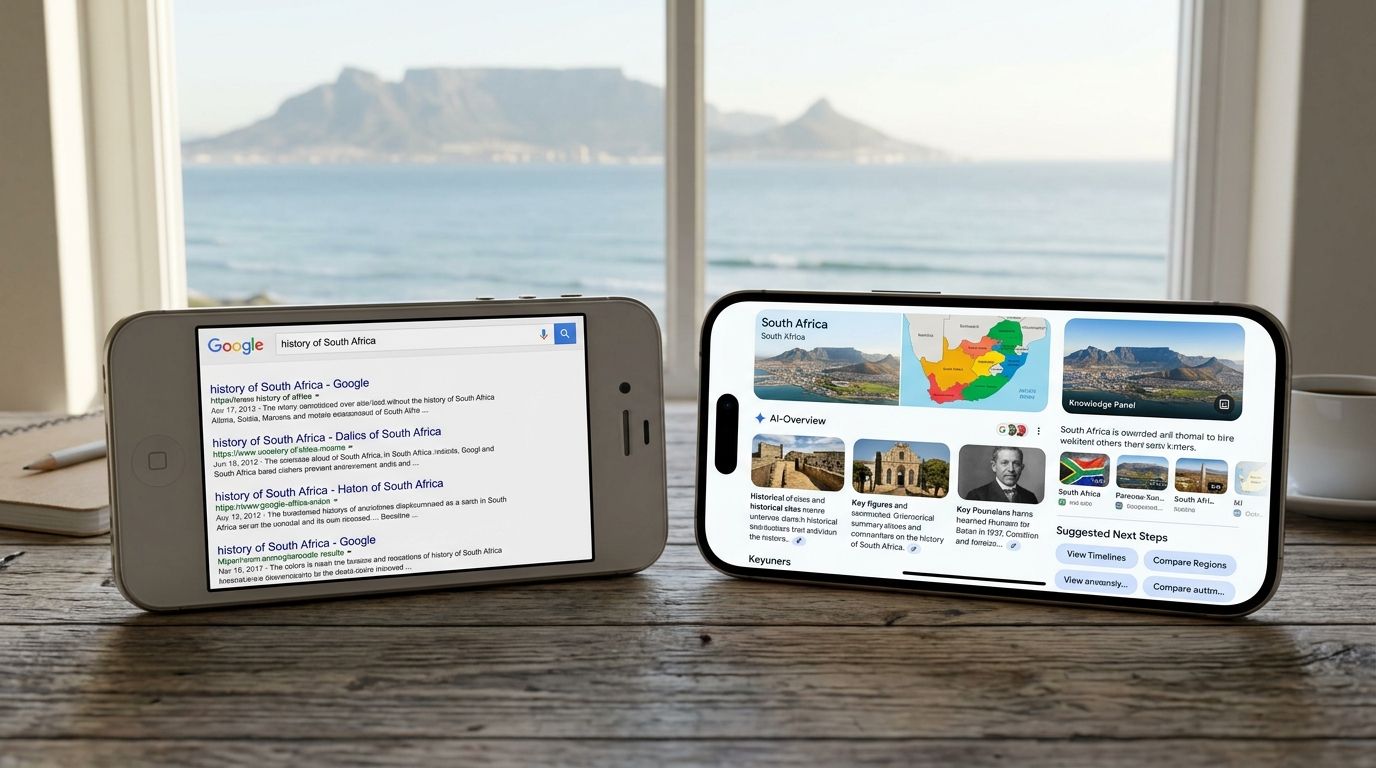
And now, from 2020 onward, we've entered the AI era. AI-powered tools — Google's AI Overviews, ChatGPT, Perplexity, Gemini, Claude and Microsoft Copilot — increasingly answer people's questions directly, by summarising information pulled from websites, directories and review platforms.
Here's the through-line across every era:
| Period | What the website mainly did | What it meant if you didn't have one |
|---|---|---|
| 1990s–2000s | Static brochure | Limited visibility; mostly offline customers |
| 2005–2010 | Search engine entry point | Harder to rank; lower organic visibility |
| 2010–2015 | Mobile conversion hub | High mobile abandonment; lost urgent jobs |
| 2015–2020 | Local SEO + reputation core | Lower local rankings; weaker trust signals |
| 2020–present | AI discovery + multi-channel anchor | Risk of being left out of AI answers entirely |
Each shift didn't replace the last one — it stacked on top. Google didn't kill word of mouth. AI won't kill Google. But each new layer rewards the businesses that give it something solid to work with.
What "AI Search" Actually Means (In Plain English)
Let's demystify the jargon, because the concepts are simpler than they sound.
Large Language Models (LLMs). ChatGPT, Gemini, Claude and the others are built on large language models. Think of an LLM as an extremely well-read assistant that has absorbed enormous amounts of text and learned the patterns of how language and facts fit together. It doesn't "look things up" in a filing cabinet — it predicts helpful answers based on everything it has learned. That's why it can answer in full sentences, like a knowledgeable person would, instead of just handing you ten blue links.
AI search. This is what happens when that assistant is pointed at a real question — "find me a good roofer in Paarl" — and responds with a direct answer or a short recommended list, rather than a page of results for you to sift through yourself.
Retrieval. Because an LLM's built-in knowledge can be out of date, modern AI search tools often retrieve fresh information from the live web before answering. They go and fetch current pages, then summarise what they find. This is why what's published about your business — and where — genuinely matters. If there's nothing solid to retrieve, there's nothing to recommend.
Structured information. This means facts laid out in a clean, consistent, machine-readable way: your business name, address, phone number, hours, services, area served. Humans can read a messy page and figure it out. Machines strongly prefer information that's clearly labelled and organised.
Business entities and knowledge graphs. To a search or AI system, your business is an "entity" — a distinct thing it tries to understand, the same way it understands a person or a place. A "knowledge graph" is the web of connections it builds around that entity: this business, in this town, offers these services, has these reviews, sits at this address. The clearer and more consistent your information is across the internet, the more confidently the system understands who you are — and the more confidently it can put you forward.
Schema markup. This is a bit of behind-the-scenes code on a website that spells out, in a language machines understand, "this is the business name, this is the phone number, these are the services, this is the rating." You never see it as a visitor, but it helps both Google and AI systems read your business accurately instead of guessing. This is one of the practical technical advantages a proper website has that a Facebook page simply cannot offer.
The one-sentence version: AI systems recommend businesses they can clearly understand and confidently trust — and both of those depend on there being good, consistent, structured information about you out there to read.
How ChatGPT, Gemini, Perplexity, Claude and Google AI Overviews Differ From Old Search
Traditional Google search gives you a list of links and lets you decide. AI search does more of the deciding for you. That single change is the heart of what's shifting.
Here's roughly how each behaves:
- Google AI Overviews appear at the top of ordinary Google results — an AI-written summary that answers the question directly, drawing from multiple sources, before you scroll to the familiar links.
- ChatGPT answers conversationally. Ask it for a recommendation and, depending on its setup, it draws on what it has learned and (when web access is on) what it can retrieve live, then hands you a tidy answer.
- Perplexity is built specifically as an "answer engine." It searches, summarises, and shows its sources — useful for people who want a direct answer and want to see where it came from.
- Gemini is Google's AI assistant, woven through Google's products and increasingly through Android phones and Maps.
- Claude is a conversational AI assistant that can research and summarise information to answer questions in plain language.
They differ in the details, but they share one habit that changes everything for a small business:
Instead of showing ten options, they often present a few — or one. When a person asks "who's the best electrician in my area," a traditional search returned a page of possibilities. An AI assistant may name two or three. The competition for that shortlist is far more intense, because there are fewer slots. Being "findable" is no longer enough; you need to be clearly the kind of business an AI feels safe recommending.
The report this article draws on is candid about the risk: businesses without websites are increasingly at risk of being underrepresented or left out of AI-generated answers, especially for professional services and more complex questions. If the AI can't find trustworthy, structured information about you, it will quietly recommend someone it can verify instead.
Where AI Gets Its Information About Your Business
This is the practical crux, so it's worth being precise. According to the research, AI systems typically discover and assess local businesses by:
- Scanning websites, directories, review platforms and social profiles.
- Prioritising authoritative, structured and consistent sources.
- Using content quality, backlinks (other reputable sites linking to you) and structured data to judge how reliable you are.
Read that again, because it tells you exactly what to do. AI leans on:
- Website content and structured data — the richest, most controllable source of facts about you.
- Authoritative sources and backlinks — signs that others vouch for you.
- Consistent NAP — your Name, Address and Phone number matching everywhere they appear.
That last one is deceptively important. If your business name is spelled one way on Facebook, another way on your Google Business Profile, and your old phone number is still floating around a directory, you're making the AI's job harder. Inconsistency creates doubt — and a doubtful system recommends someone else.
Why Websites Still Matter — More Than Ever
It's tempting to assume that if AI answers questions directly, websites become irrelevant. The research points firmly the other way.
Websites remain the primary source of business information that AI and search systems rely on. A website is the one place where you have full control to present:
- Clear, detailed service descriptions — what you actually do, in your own words
- Location and area served — so you're matched to the right local searches
- Certifications, qualifications and credentials — the trust signals professionals live and die on
- Case studies, project photos and testimonials — proof, not just claims
- Consistent branding — a coherent story rather than fragments scattered across platforms
Crucially, a website is where structured data (schema) lives. That's the machine-readable layer that helps Google and AI understand your business accurately. A Facebook page and a Google Business Profile can't offer that in the same way.
There's a trust dimension too. Consumers — not just algorithms — perceive businesses with professional websites as more established, more professional and more reliable, particularly for professional services and higher-value trades like solar installation and building. That perception feeds reviews, referrals and pricing power. And AI systems, trained on how humans assess credibility, tend to reflect the same instincts.
A website isn't the thing you build instead of everything else. It's the anchor that makes everything else — your Google Business Profile, your reviews, your social media, your referrals — work harder and read more clearly to both people and machines.
Why Facebook and Google Business Profile Alone Aren't Enough
Plenty of South African businesses run entirely on a Facebook page and a WhatsApp number. It works — up to a point. Here's where it hits its limits.
Facebook pages are good for engagement and community, but they carry limited SEO value and little structured data. They're "rented land" — you're subject to a platform's algorithm and rules, and you don't fully own your data or your reach. For professional services especially, a Facebook page alone is often perceived as less formal and less credible than a website.
Google Business Profile is genuinely important — it's central to local discovery and Google Maps, and you should absolutely have one. But on its own it has limits. Without a website behind it, a profile tends to be seen as less complete, and it lacks the depth of content and structured data that strengthen both rankings and AI understanding. The research is consistent: businesses with both a profile and a website outperform profile-only businesses.
WhatsApp Business is a South African strength — brilliant for quick queries and closing informal deals. But it's a communication tool, not a discovery tool. It doesn't help a stranger find you, and it doesn't give AI anything to read.
Here's a quick, honest comparison based on the research:
| Channel | Great for | Real limitation |
|---|---|---|
| Professional website | Full control, SEO, AI readability, detailed info, structured data | Requires setup and upkeep |
| Google Business Profile | Local discovery, Maps, reviews | Weaker and less complete without a website |
| Engagement, community | Limited SEO, "rented land," less formal for pros | |
| Visual work (artisans, makers) | Little text detail or searchability | |
| WhatsApp Business | Direct chat, informal sales | No discovery; nothing for AI to read |
| TikTok | Reach and awareness, younger audiences | Weak for detailed info and formal trust |
| Word of mouth | Deep trust in your existing circle | Can't reach strangers or scale beyond your network |
None of these is wrong. The mistake is relying on only the ones that can't be found or read by the systems that now do the recommending.
How All the Pieces Work Together
The channels above aren't rivals. They're a team, and each covers for the others' weaknesses.
Think of the modern customer journey as multi-touch. Someone rarely decides from a single source. According to the research, the typical path looks like this:
- Discovery — via search, Maps, social, an AI assistant, or a recommendation
- Research — checking your website, Google Business Profile, reviews and social
- Comparison — weighing price, quality, reviews and availability against others
- Contact — phone, WhatsApp, email or a booking form
- Purchase or booking
- Post-purchase — leaving a review, referring a friend, coming back
Businesses without websites tend to stumble at steps 2 and 3 — exactly where people want detailed information to compare and feel confident. Fragmented information across a few platforms reads as less coherent and less professional.
Here's the reinforcing loop when it's working well:
- Your website holds the full, structured story and feeds accurate information to search and AI.
- Your Google Business Profile puts you on Maps and in local results, and links to that website for depth.
- Your reviews provide social proof that both humans and AI weigh heavily.
- Your social media builds familiarity and engagement, and points back to the website.
- Google Search, Maps, AI Overviews and assistants like ChatGPT and Perplexity all draw on this same consistent web of information — and the more consistent it is, the more confidently they present you.
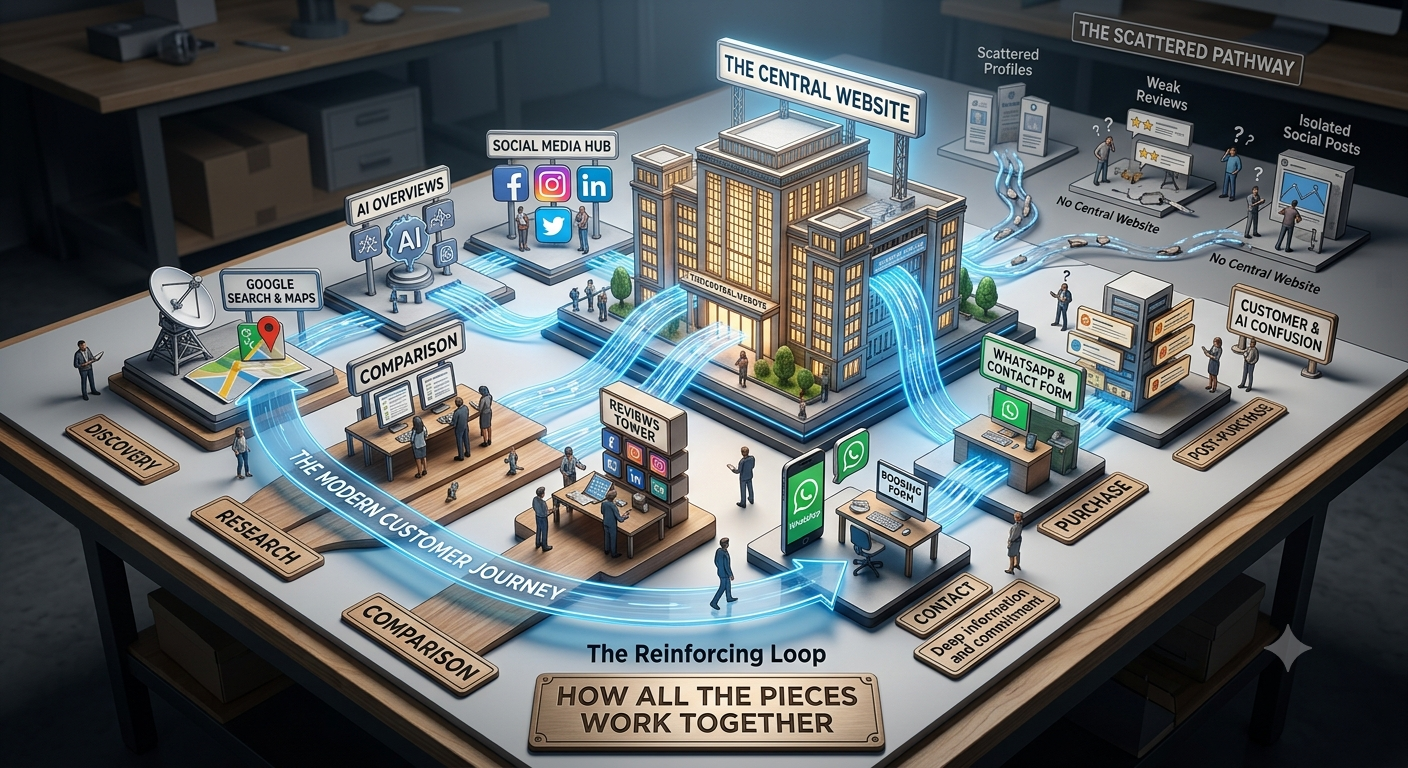
Get one channel right and you help a little. Get them consistent and connected — with a website at the centre — and each one makes the others stronger.
What Makes AI More Likely to Recommend You
Pulling the research together, AI systems are more likely to recommend businesses that offer:
- Clear information — no ambiguity about what you do or where
- Consistent branding — the same name, look and message everywhere
- A professional website — the anchor and richest source of facts
- Location information — so you match local, intent-driven searches
- Service descriptions — specific, plain-language detail on your work
- Customer reviews — verifiable social proof
- Structured data — the machine-readable layer that removes guesswork
- High-quality content — genuinely useful information, well presented
Notice what these have in common: none of them is a trick. They're simply the marks of a business that has its house in order. AI didn't invent these standards — it inherited them from how people judge credibility, and then made them non-negotiable, because a machine can't give an unclear business the benefit of the doubt the way a human sometimes will.
The Future of AI Search: The Next Ten Years
Where is this heading? The research is measured rather than sensational, and worth taking at face value. A few clear directions:
Greater reliance on AI Overviews and conversational search. Answering questions directly — rather than returning links — is expected to keep expanding. More customers will get a recommendation without ever visiting a results page.
More weight on authoritative sources and structured data. As AI matures, it's expected to lean even harder on trustworthy, well-structured, consistent information. The businesses that invest in clarity now are the ones most likely to be surfaced later.
Voice-first and multimodal search. People increasingly search by speaking — "Hey, find me a physio open on Saturday in Paarl" — and by combining voice, text and images. Voice results, like AI answers, tend to return very few options. There's little room to be the eighth-best choice.
Personal AI assistants. The research anticipates AI assistants that know your preferences and history, and that handle discovery on your behalf — quietly filtering the options before you ever see them.
Agentic AI and automated procurement. This is the furthest-looking and most important shift. The report raises the prospect of autonomous AI agents that book services, compare prices and even negotiate on a customer's behalf. Picture someone telling their assistant, "sort out a plumber for the leak," and the agent doing the finding, vetting and booking itself. An agent like that can only choose from businesses it can find, read and verify. If your information isn't clear and structured, you're not in the running — and no human ever sees you to override it.
The report is direct about the stakes over the coming decade: businesses without websites may face significant disadvantages in discovery and automated decision-making, as digital trust and data quality become even more critical.
This isn't a reason to panic. It's a reason to prepare calmly, starting with the fundamentals, while the advantage still goes to those who move early.

How to Prepare Your Business for AI Search
The reassuring part: preparing for AI search doesn't require you to become technical or chase every trend. It means getting the basics genuinely right and keeping them consistent. Here's a practical, prioritised checklist — and why each item matters.
1. Keep your business information accurate and consistent everywhere.
Make sure your name, address, phone number, hours and services match across your website, Google Business Profile and every social platform. Why it matters: consistency is how AI and search build confidence that they understand who you are. Contradictions create doubt, and doubt costs you the recommendation.
2. Have a professional website — and treat it as your anchor.
This is the single highest-leverage move. Why it matters: your website is the richest, most controllable source of information about you, the home of your structured data, and the strongest trust signal for both people and machines. It makes every other channel work harder.
3. Keep your Google Business Profile complete and up to date.
Fill in every field, add photos, list your services, keep your hours current. Why it matters: it's central to local discovery and Maps, and it performs best when it links to a real website behind it.
4. Earn customer reviews — and respond to them.
Ask happy customers to leave honest reviews, and reply to them. Why it matters: reviews are among the strongest trust signals for both consumers and AI. The research notes people are markedly more likely to choose businesses that respond to reviews.
5. Publish useful, high-quality content.
Service pages, simple guides, project write-ups, answers to common questions. Why it matters: good content demonstrates expertise, matches the specific things customers search for, and gives AI something substantial and quotable to draw on.
6. Use structured information (schema) on your website.
Make sure your site clearly labels your business details in a machine-readable way. Why it matters: it removes guesswork, helping Google and AI understand and present your business accurately. This is a genuine advantage a website has that social pages don't.
7. Keep your information mobile-friendly and fast.
Why it matters: most South African local searches happen on phones, often with urgent intent. A slow or clumsy mobile experience loses immediate-demand customers — the plumbing emergencies and lockouts that convert fastest.
8. Keep everything current.
Update hours over holidays, add new services, refresh photos. Why it matters: AI increasingly retrieves live information. Stale details don't just look bad — they can get you filtered out.
You don't have to do all eight this week. Start with consistency (1) and a proper website (2); those two alone move you ahead of most competitors who are still running on a Facebook page and hoping.
An Honest Word on What We Know and Don't Know
Good advice includes its own limits, so here's the honest picture.
Much of the hard, quantified data behind these trends comes from studies in the US, UK and Australia — large, recent samples, but not South Africa specifically. Rigorous, peer-reviewed South African studies putting an exact rand figure on "lost revenue from having no website" are limited. Where this article implies numbers, it's drawing on international patterns and South African context (from sources like FinScope MSME and industry analyses), not a precise local measurement.
That said, the direction is not seriously in doubt. South Africa's mobile connectivity is high and growing, urbanisation is rising, and international digital trends have consistently reached the country — usually with a lag, and with a stronger reliance on WhatsApp and informal networks than elsewhere. It's reasonable to expect these shifts to land here too, shaped by local realities.
So treat the specifics as well-founded indications rather than guarantees, and treat the underlying message as solid: the businesses that give people and AI clear, trustworthy, consistent information are the ones most likely to keep getting found and recommended.
Frequently Asked Questions
Can ChatGPT actually recommend my business?
It can. When someone asks an AI assistant for a local recommendation, it draws on what it has learned and — when it has web access — what it can retrieve live. If there's clear, trustworthy, structured information about your business online, you can be included. If there isn't, it will recommend a competitor it can verify instead.
Is Google AI replacing traditional Google search?
Not replacing — layering on top. Google AI Overviews now appear above the familiar links, answering many questions directly. Traditional results, Maps and Google Business Profile all still matter. The change is that fewer people scroll past the AI summary, so being surfaced in it becomes more valuable.
Do websites still matter if AI just answers questions directly?
Yes — arguably more than before. Websites remain the primary source AI and search systems rely on for business information, and they're where your structured data lives. AI answering directly makes it more important to have solid, readable information for it to pull from.
Isn't AI search only a big-company problem?
No. It directly affects how customers discover local businesses — plumbers, electricians, accountants, artisans and the rest. If anything, small local businesses have the most to gain from getting discovered by AI, and the most to lose from being invisible to it.
I only have a Facebook page. Is that enough?
It's a start, but it has real limits: weak SEO value, little structured data, and it's a platform you don't own or control. For being found and recommended by search and AI — especially for professional or higher-value services — a Facebook page alone leaves you at a disadvantage.
I have a Google Business Profile. Do I still need a website?
A Google Business Profile is important and you should keep it complete. But the research is consistent: businesses with both a profile and a website outperform those with a profile only. A website adds the depth, control and structured data that a profile can't provide on its own.
What is schema / structured data, in one line?
It's behind-the-scenes code on your website that spells out your business details in a language machines understand — so Google and AI read your business accurately instead of guessing.
What's the single most important thing I can do right now?
Make your core details — name, address, phone, hours, services — accurate and identical everywhere they appear online, and give yourself a proper website to anchor them. Consistency plus a real website is the foundation everything else builds on.
What is "agentic AI" and should I worry about it?
It refers to AI assistants that can act on your behalf — potentially finding, comparing and even booking a service for you. It's still emerging, so there's no need to panic. But it reinforces the same fundamentals: an agent can only choose businesses it can clearly find, read and verify.
Does voice search change anything for me?
Yes. Voice results, like AI answers, usually return very few options — often just one or two. That raises the bar: it's not enough to be findable, you need to be a clear, trustworthy top choice, backed by consistent, well-structured information.
Where This Leaves You
The tools keep changing — Yellow Pages, Google, Maps, and now AI assistants and voice. What customers need has never changed: a trusted way to find out who exists and who's worth calling. What has changed is that the new gatekeepers can't give an unclear business the benefit of the doubt. They recommend what they can understand and verify.
So the question worth sitting with is simple and practical: Does your business currently provide enough clear, trustworthy, consistent information for both a person and an AI to confidently recommend it?
If a customer — or their AI assistant — went looking for you today, would they find a coherent, professional picture? Or scattered fragments and a few mismatched details?
A professional website doesn't replace your Google Business Profile, your reviews, your referrals or your social media. It strengthens all of them — giving people and AI systems one clear, structured, trustworthy source to draw on. If you're not sure your business would pass that test yet, that's not a failing. It's simply the next thing worth getting right.

Google Business Profile Optimization: The 2026 SA Guide
Why some Google Business Profiles rank in Maps and others don't — plus a practical checklist of the tweaks that actually move you above competitors.
5 Ways a Website Wins Your Trade Business More Local Jobs in SA
Your trade business is losing work every week without a website. Here is what it costs you, backed by research, and the simple fixes that bring local customers in.