5 Ways a Website Wins Your Trade Business More Local Jobs in SA
Your trade business is losing work every week without a website. Here is what it costs you, backed by research, and the simple fixes that bring local customers in.

Let me guess how your work comes in right now.
Someone you did a good job for tells their neighbour. The neighbour phones you. You quote, you show up, you do solid work, and the chain carries on. Referrals. That is how most good trade businesses in South Africa have run for decades, and there is nothing wrong with it.
But here is the part nobody tells you.
That neighbour who got your number? Before they phone you, most of them do one quiet thing first. They type your name into Google. Or they skip your name entirely and search "plumber near me" or "electrician in Somerset West" to see who else is around. And in that thirty seconds, on a phone, standing in their kitchen, they decide whether you look like a real business or a risk.
If there is nothing there, or only an old Facebook page from 2019, you have already lost points before the phone even rings. Sometimes the phone does not ring at all.
This article is not a sales pitch dressed up as advice. It is a plain look at what actually happens when a customer goes looking for someone like you, backed by real research, and five specific ways a proper website turns more of those searches into paying jobs. No hype. No pressure. Just what the evidence shows.
Table of Contents
- First, a quick reality check
- Way 1: A website makes strangers trust you before you say a word
- Way 2: A website helps Google actually show your business
- Way 3: A website works while you are asleep, on a roof, or under a sink
- Way 4: A website gets you found by AI, not just Google
- Way 5: A website ties all your scattered channels into one
- How it all fits together
- A simple test before you spend a cent
- Frequently asked questions
First, a quick reality check
Before we get to the five ways, it helps to see how buying decisions actually happen now, because it has changed more than most people realise.
Think of the last time you needed a service you had never used before. A dentist in a new town. A place to fix your bakkie's aircon. What did you do? You almost certainly searched, read a few things, glanced at some reviews, and then made contact. You did not just phone the first number you saw.
Your customers do exactly the same thing to you.
The research on this is strong, though most of the big numbers come from studies in the United States, the United Kingdom and Australia. South Africa does not yet have surveys at that scale, so I will be honest about that throughout. But the direction is the same everywhere, and South Africa is heading there fast as mobile internet use keeps climbing.
Here is what those international studies found:
- Around 80% of consumers search online for local businesses every week, and about a third search every single day. (BrightLocal, Top Local Manager, 2024 data.)
- In a 2025 US study of over 1,000 people, 84% said they search for local businesses online daily. (Rio SEO.)
- 91% use online search at some point when deciding on a local business. (Top Local Manager.)
Even if South Africa lags these numbers, the behaviour is the same. People look you up. The only question is what they find when they do.
And it is not just searching. It is checking whether you are worth the risk:
- 87% of consumers read online reviews before choosing a local business.
- 77% won't even consider a business rated under three stars.
- 75% read at least four reviews before deciding. (Top Local Manager and Rio SEO, 2024 to 2025.)
Now hold that picture in your head. A customer, on a phone, searching, reading, comparing, and deciding in a couple of minutes. Everything below is about making sure that decision goes your way.
Way 1: A website makes strangers trust you before you say a word
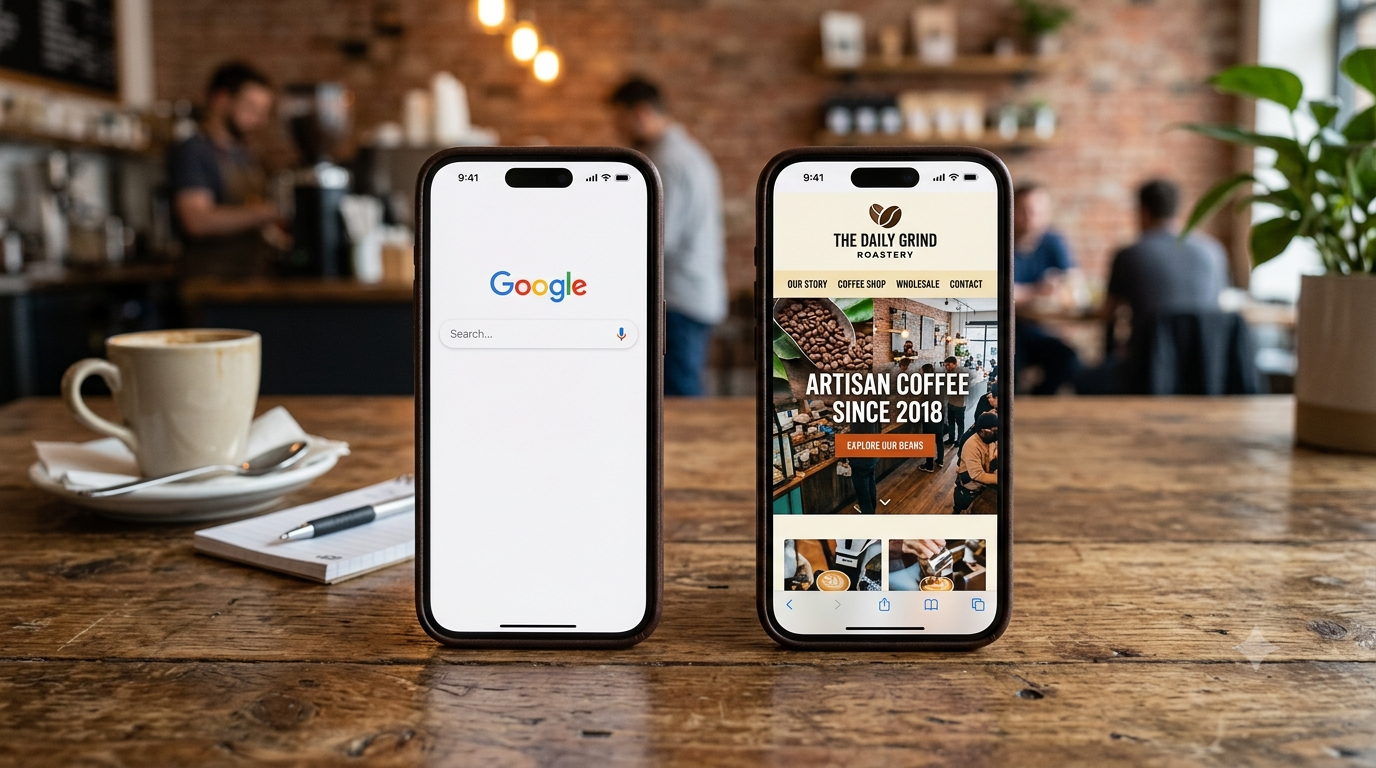
Referrals work because trust is borrowed. Your happy customer lends you their credibility, and their friend trusts you on that basis. That is powerful, and a website does not replace it.
But referrals only reach people who already know someone who knows you. Everyone else, the much larger group, meets you cold. A stranger searching for a roofer has no borrowed trust to lean on. They have to build it from scratch, in seconds, from whatever you have put online.
This is where most trade businesses quietly lose work.
Why a stranger's brain treats "no website" as a warning sign
When someone finds a business with a real website, clear photos, a list of services, and an obvious way to get in touch, their brain files it under "established and safe." When they find almost nothing, or a dead social page, the same brain files it under "maybe, but risky."
The research backs this up. Businesses with professional websites are consistently seen as more trustworthy, more established, more professional and more competent than those relying on social profiles alone. This effect is strongest exactly where the money is: higher-value trades like solar installers, builders and roofers, and professional services where the customer is taking a real risk on quality.
One South African analysis put it bluntly: roughly 80% of consumers search online before buying, and if a business is nowhere to be found, many simply assume it is not a legitimate operation.
Think about what that means for a builder. A homeowner planning a R150,000 extension is not going to hand that job to a name and a cell number they found on a lamp post. They want to see previous work, understand the process, and feel like they are dealing with a proper company. A website lets you show all of that on your terms.
What a trust-building website actually needs (it is less than you think)
You do not need a fancy, animated, ten-page monster. For trust, a customer really wants to see:
- Who you are and the area you cover
- What you do, in plain words, listed clearly
- Proof you have done it before, real photos of real jobs
- A sign you are qualified, like a COC for electrical work, or relevant registrations
- An easy way to reach you, phone, WhatsApp, or a short form
That is it. That is the difference between "looks legit" and "looks risky."
A social media page can look busy but still feel like rented space. A website feels like a shop you own. For a stranger deciding whether to trust you with their home or their money, that difference matters.
A quick example
A painter in Cape Town relies entirely on word of mouth. Good work, loyal customers. But every time a past client recommends him, the new person searches his name, finds one Facebook page last updated two years ago, and hesitates. Half of them still call. The other half quietly phone the painter whose website shows fifteen finished projects, a clear list of services, and a "request a quote" button.
The referral did its job. The missing website undid half of it.
Way 2: A website helps Google actually show your business
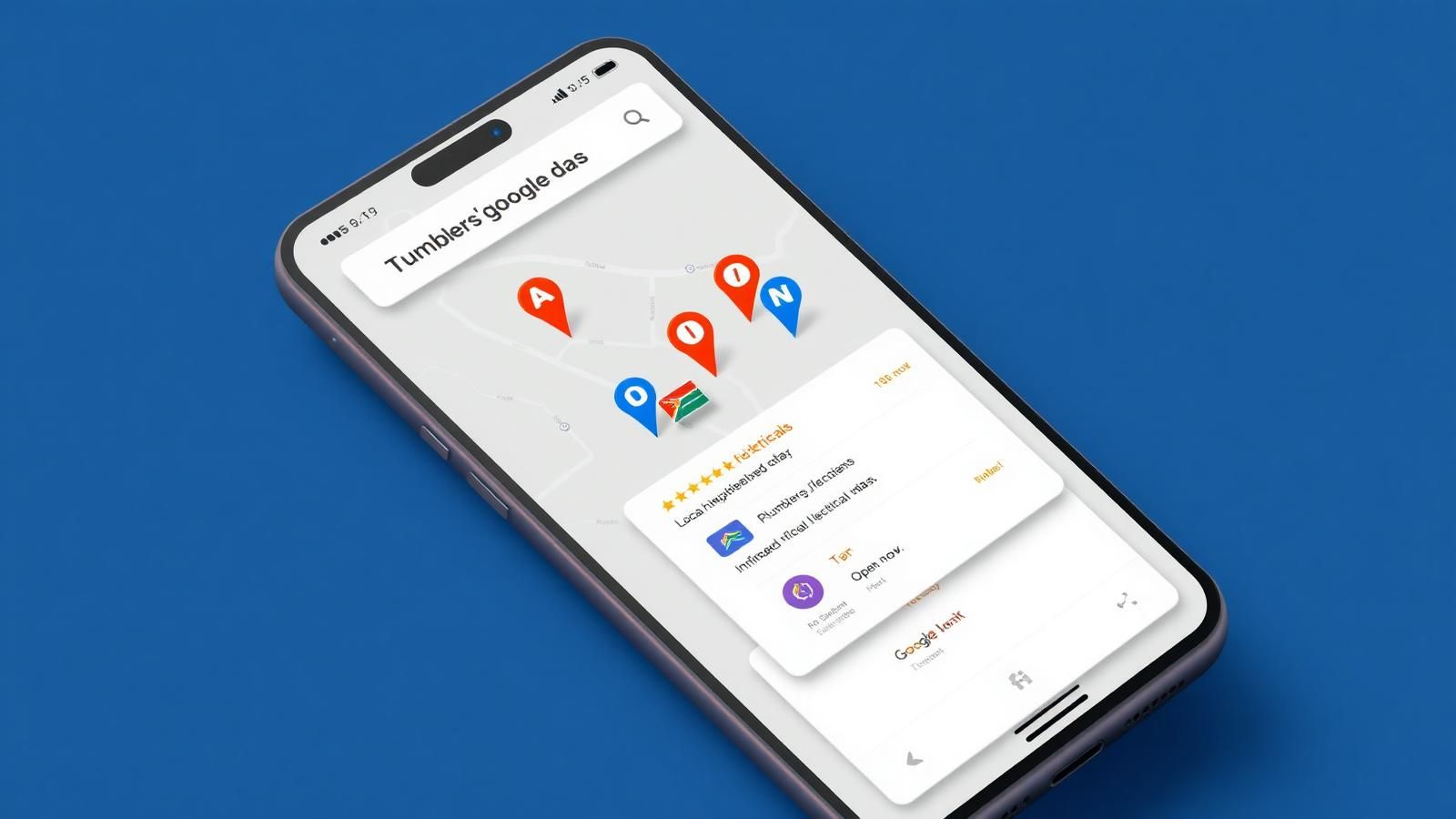
Here is a common and costly misunderstanding. Many trade owners believe that having a Google Business Profile, that free listing that puts you on Google Maps, is the same as "being on Google." It is a great start, but it is only half the machine.
Google Business Profile is the front door. Your website is the house.
Your Google Business Profile is what shows up on the map with your pin, your hours and your reviews. You should absolutely have one, and it is free. But Google decides who ranks above whom, and to make that decision it looks for more than just a pin.
Google's ranking system leans on things like:
- Content that clearly explains what you do and where
- Structured information that tells Google "this is a plumbing business in Paarl serving these suburbs"
- Consistent name, address and phone number across the web
- Links and signals from other sites that suggest you are real and trusted
A Google Business Profile on its own gives Google very little of this. A website gives it plenty.
That is why the research is consistent on this point: businesses that have both a Google Business Profile and a website outperform those with only a profile, on clicks, on enquiries, and on conversions. The two work together. The profile gets you onto the map. The website gives Google the substance it needs to rank you higher and gives the customer a reason to choose you.
What "local SEO" really means for a tradesman
Local SEO sounds like jargon, so let me make it concrete. It simply means being the business that shows up when someone nearby searches for what you do.
When a person types "emergency electrician Stellenbosch" at 8pm, Google is trying to answer one question: who near this person is the best match, right now? To answer it well, Google needs pages that actually talk about being an electrician, in Stellenbosch, for emergencies. A website can have exactly those pages. A Facebook profile cannot, not in a way Google understands and rewards.
This is why a website with a page per service, and clear mention of the towns you serve, quietly does work for you every hour of every day. It is answering Google's question before the customer even finishes typing.
Being on the map is good. Being the one who ranks at the top of the map, and then has a proper site to click through to, is what actually wins the job.
A quick example
Two electricians in the same town. Both have a Google Business Profile. One also has a simple website with separate pages for "home electrical," "solar installation," "COC certificates" and "emergency call-outs," each mentioning the areas he covers.
Guess which one Google trusts more when someone searches "solar installer near me." Guess which one gets the call.
Way 3: A website works while you are asleep, on a roof, or under a sink

You cannot answer your phone when you are lying under a sink with a pipe wrench, on a roof in the wind, or asleep at 11pm. But that is often exactly when people decide they need you.
A burst geyser does not wait for business hours. Nor does a tripped DB board, a blocked drain, or a leaking roof in the middle of a storm. When someone has an urgent problem at an awkward time, they search, and they want to act now.
The missed-call problem is bigger than you think
If your only way in is a phone number, then every call you cannot take is a coin flip. Some people leave a message. Many just dial the next result. In the trades, where jobs are often urgent, the customer who cannot reach you at 9pm has usually booked someone else by 9:15.
The international research shows this clearly: mobile users who cannot find an easy way to act are far more likely to abandon one business and switch to a competitor who makes it simple. On a phone, in a hurry, patience is thin.
A website closes that gap. It can:
- Take an enquiry at any hour through a simple form or WhatsApp button, so the lead is captured even when you are unavailable
- Answer common questions ("do you do after-hours call-outs?", "which areas do you cover?", "roughly what does a COC cost?") so people self-qualify before they contact you
- Let people book a slot without a single phone call, using a simple booking calendar
That last one matters more than it sounds. Every question a customer can answer for themselves on your site is a phone call you did not have to interrupt your work for, and a lead that did not slip away because you were busy.
After-hours is not a small slice. It is a lot of your best work.
Emergencies pay well and they happen at bad times. A geyser that bursts on a Sunday night is a high-value, high-urgency job. If your competitor's website quietly captures that enquiry while you are asleep, that is not a missed call. That is a missed month's worth of a customer, because urgent jobs done well turn into loyal, repeat customers.
Your website is the one employee who never sleeps, never takes leave, and never lets a lead ring out. For a one-person or small trade business, that is not a luxury. It is leverage.
A quick example
A plumber adds a "request a callout" form and a WhatsApp button to his site. Over a month, six enquiries come in after 7pm, three of them on weekends. Before the website, most of those people would have phoned the next plumber on the list. Now they land in his inbox, ready for him to reply first thing. Same plumber. Same skills. Six more chances at work.
Way 4: A website gets you found by AI, not just Google
This is the part most trade businesses have not caught up with yet, and it is exactly why getting ahead of it now is worth so much.
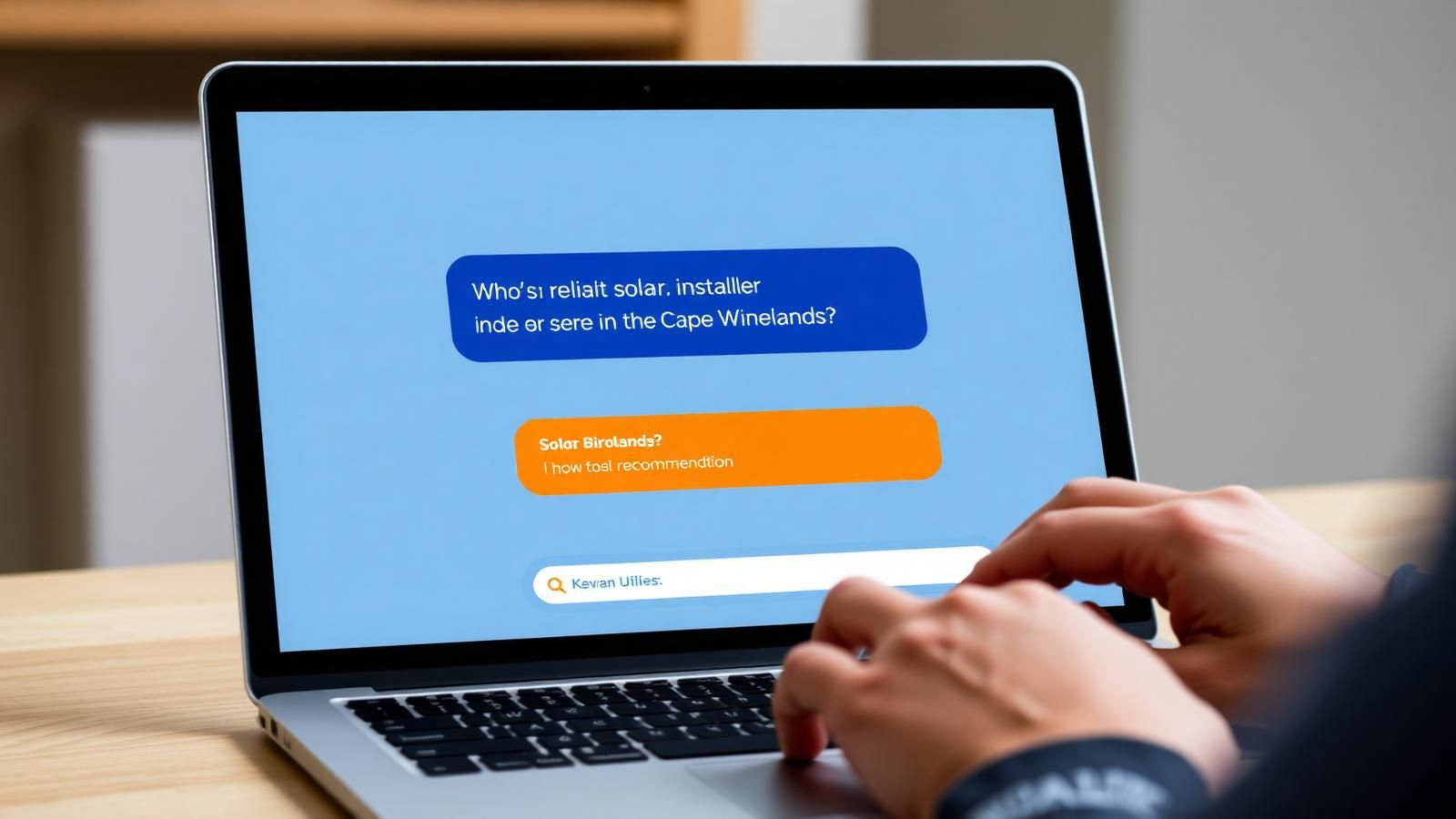
More and more people are not searching the old way. Instead of scrolling through Google results, they ask an AI assistant a plain question and expect a plain answer. Tools like ChatGPT, Google's AI Overviews, Perplexity and Gemini are increasingly how people find things, including local services.
Someone might now type: "Who's a reliable solar installer in the Cape Winelands?" and expect the AI to just tell them, names and all.
Where do these AI tools get their answers?
Here is the crucial bit, in plain English. These AI systems do not invent recommendations out of thin air. They build their answers by reading the web, websites, directories, review platforms, and pulling together whatever looks trustworthy and consistent.
The research on how they work points to a few things they rely on heavily:
- Website content they can actually read and understand
- Structured information (that behind-the-scenes labelling that says "this is a business, this is its location, these are its services")
- Consistent details about your name, address and phone number across the different places you appear
- Signs of authority, like other reputable sites referencing you
Now notice what is missing from a business with no website. All of it. If an AI tool is assembling a shortlist of trustworthy local tradesmen and you have nothing for it to read, you are simply not in the running. You cannot be recommended by something that cannot find you.
Why AI makes a website more important, not less
It would be easy to assume that AI doing the searching means you need to do less. The opposite is true.
When a human searches, they might scroll, get curious, and click on a business with a thin online presence just to see. AI does not get curious. It works from what it can verify. A business with no readable, structured, consistent web presence is far easier for an AI to skip entirely.
The research is direct about this risk: businesses without websites are increasingly likely to be underrepresented or left out of AI-generated answers, especially for anything beyond the simplest query. And this is only going to grow. The expectation over the next five to ten years is more AI-driven discovery, and eventually AI assistants that book and compare services on a person's behalf. You want to be a business those systems can see and recommend.
Being invisible to Google costs you customers today. Being invisible to AI will cost you customers tomorrow. A website is how you stay visible to both.
A quick example
Two roofers serve the same region. One has a clear website describing their services, areas and past work, with consistent contact details everywhere they appear. The other has only a phone number and a quiet Facebook page.
When a homeowner asks an AI assistant to suggest a trustworthy roofer in the area, only one of them has any chance of being named. It is not about who is the better roofer. It is about who the machine can actually read.
Way 5: A website ties all your scattered channels into one
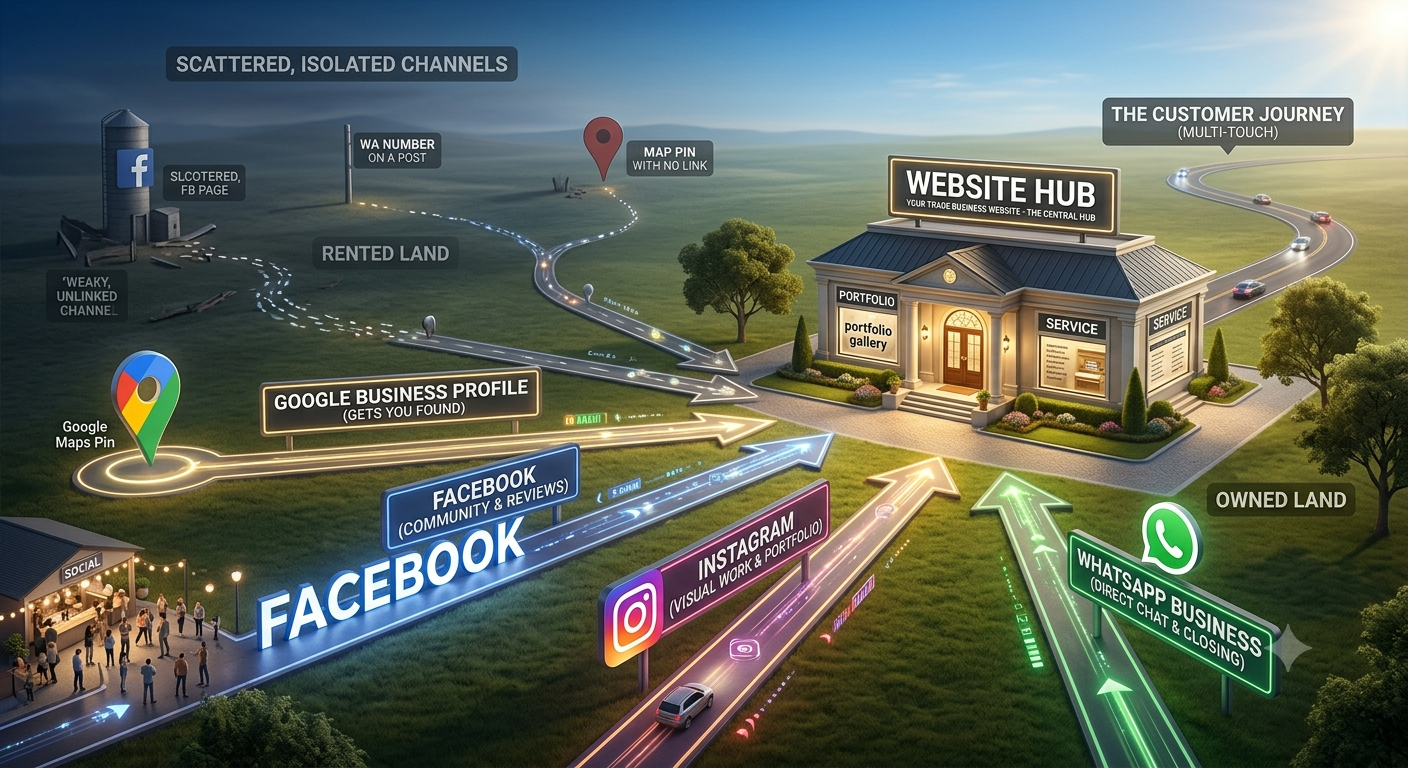
Most trade businesses do not have no online presence. They have a scattered one. A Facebook page here. A WhatsApp Business number there. A Google Business Profile. Maybe an Instagram with a few job photos. Each doing a little, none pulling together.
That scattering is the problem a website solves that nothing else can.
Every channel is good at one thing, and weak at others
Let me be fair to each of them, because they all have a real job to do:
| Channel | What it is good at | Where it falls short |
|---|---|---|
| Google Business Profile | Getting you on the map and showing reviews | Thin on detail; limited without a website behind it |
| Community, sharing, staying in touch | Weak for search; feels informal for bigger jobs | |
| Showing off visual work, before-and-afters | Little detail; hard to search; poor for enquiries | |
| WhatsApp Business | Fast, direct, personal chat, huge in SA | Poor for being discovered; no real detail or search |
| Word of mouth | The strongest trust there is | Only reaches people already in your network |
See the pattern? Each channel is a good spoke. None of them is the hub.
WhatsApp is brilliant for talking to a customer once they have found you, but nobody discovers a new plumber by searching WhatsApp. Facebook keeps you in touch with people who already like you, but it does not help a stranger in the next suburb. Word of mouth is gold, but it stops at the edge of your existing circle.
The website is the hub the spokes point to
A website is the one place you fully own and control, where all these channels can lead. Your Google Business Profile links to it. Your Facebook "learn more" button points to it. Your WhatsApp status can send people there. Your business card carries the address.
The customer's journey almost never happens on one channel. The research describes it as multi-touch: someone discovers you on the map, checks your reviews, glances at your Facebook, and then wants the full picture before they commit. Without a hub, they are left stitching together fragments, and fragments feel unprofessional. With a website, they land somewhere complete, consistent and reassuring.
Social profiles and WhatsApp are rented land. The algorithm changes, the rules change, and your reach can vanish overnight. A website is land you own. Everything else should point back to it.
This is the mindset shift that matters most. A website does not compete with your referrals, your WhatsApp or your Google profile. It completes them. It is the missing centre that makes everything else work harder.
A quick example
A landscaper posts great before-and-after photos on Instagram and chats to clients on WhatsApp. But there is nowhere to send a serious enquiry to see pricing guidance, service areas and a proper portfolio in one place. Add a simple website, and suddenly Instagram drives people to something, WhatsApp closes the deal, and Google can finally rank a real business. Same tools. Now they pull in the same direction.
How it all fits together

Let me pull the five ways into one picture, because they are not five separate ideas. They are five parts of the same machine.
- Trust gets a stranger to take you seriously.
- Google visibility makes sure that stranger finds you at all.
- 24/7 availability captures them even when you cannot pick up.
- AI visibility keeps you in the running as search itself changes.
- One hub makes every other channel you already use work better.
Here is the honest summary, including the limits of the evidence:
- The hard statistics come mostly from the US, UK and Australia. South Africa does not yet have studies at that scale, so treat the exact percentages as strong signals of direction, not local gospel.
- What is not in doubt is the pattern: people search, people read reviews, people judge trust in seconds, and people quietly choose the business that looks real over the one that does not.
- South Africa is moving the same way, fast, as mobile internet use keeps rising. The businesses that set up properly now will be the ones AI and Google recommend later.
None of this means abandoning what already works. Your referrals are still your best source of work. Your WhatsApp is still how you will close most jobs. Keep all of it. A website simply makes sure that when someone goes looking, and they will, you are the one they find, trust, and phone.
A simple test before you spend a cent
You do not need to take my word for any of this. Do the test yourself, right now, in two minutes.
- Pull out your phone and open Google.
- Search your business name. What comes up? Is it clear, current and reassuring, or thin and outdated?
- Now search the way a stranger would. Try "[your trade] near me" or "[your trade] in [your town]." Where are you? Are you even on the first page?
- Look at whoever is above you. Do they have a proper website? What does it show that yours does not?
- Ask an AI assistant (ChatGPT, Gemini or Perplexity) to recommend a business like yours in your area. Are you mentioned? Is anyone?
If that little test made you wince, you are not behind because you are bad at your trade. You are behind because the way customers find tradesmen changed, and nobody handed you the memo.
A professional website is how you catch up, and it should sit alongside your referrals, your Google Business Profile and your WhatsApp, not replace any of them. If you would like to see what that could look like for your specific trade, that is exactly the kind of thing we build at Proxi, in plain language, with no jargon and no pressure.
Either way, do the test. Knowing where you stand is worth something on its own.
Frequently asked questions
Do I really need a website if I get plenty of work from referrals?
Referrals are the best source of work you have, and a website does not replace them. But most people who get referred to you still look you up before they call. A website makes sure that when they do, you look like a real, trustworthy business, so more of those referrals actually turn into jobs. It also reaches the large group of customers who have no one to refer them to you at all.
Isn't a Google Business Profile enough on its own?
A Google Business Profile is essential and free, so get one. But on its own it gives Google very little to work with. The research consistently shows that businesses with both a profile and a website get more clicks, enquiries and conversions than those with a profile alone. The profile puts you on the map. The website gives Google, and the customer, a reason to choose you over the next pin.
I already use WhatsApp and Facebook. Why add a website?
WhatsApp and Facebook are excellent for talking to people who have already found you. They are weak at helping strangers discover you, and they feel informal for bigger jobs. A website is the hub all your other channels point to, the one place you own and control, where a serious customer can see the full picture before they commit. It makes your WhatsApp and Facebook work harder, not redundant.
Will a website actually bring in more jobs, or just look nice?
The value is practical, not decorative. A website builds trust with strangers, helps you rank higher on Google, captures enquiries after hours when you cannot answer the phone, and keeps you visible to AI search tools. Each of those is a real path to more enquiries. Exact returns vary by trade, but the international evidence is consistent that a website acts as a multiplier for every other bit of marketing you do.
What about AI tools like ChatGPT? Is that really relevant to a plumber?
It is becoming relevant fast. More people are asking AI assistants for local recommendations instead of scrolling Google. These tools build their answers by reading websites and other online sources. If you have nothing for them to read, you simply cannot be recommended. Setting up a proper website now is how you stay visible as this shift accelerates over the coming years.
How complicated does the website need to be?
Much simpler than most people fear. For a trade business, a customer mainly wants to see who you are, what you do, proof of past work, any relevant qualifications, and an easy way to make contact. A clear, fast, mobile-friendly site that covers those is worth far more than a big, complicated one. Simple and honest beats fancy and confusing every time.
Are these statistics based on South African data?
Mostly not, and it is only fair to say so. The large, hard-number studies come from the US, UK and Australia, because South Africa does not yet have research at that scale. What we do have locally, from sources like FinScope and various digitalisation reports, confirms that South African consumers are moving in the same direction as mobile internet use climbs. Treat the exact percentages as strong indicators of where things are heading, not as local certainties. The underlying behaviour, people searching and judging you online before they call, is already happening here.
Curious whether your trade business is easy to find online? Do the two-minute test above. If you would like a hand turning what you find into a simple, professional website that works alongside your referrals, your Google Business Profile and your WhatsApp, [that is what we do at Proxi](https://proxi.co.za).
AI Is Changing How Customers Find You
ChatGPT, Google AI and voice assistants are the new Yellow Pages. Here's how to make sure your business gets recommended.
Google Business Profile Optimization: The 2026 SA Guide
Why some Google Business Profiles rank in Maps and others don't — plus a practical checklist of the tweaks that actually move you above competitors.